
When downstream and power facilities plan a turnaround, shutdown, or major capital project, labor forecasts often focus on the trades required to execute the work. Yet securing workforce is becoming increasingly difficult. Across the industry, skilled labor remains in high demand while experienced workforce availability continues to tighten, forcing facilities to do more with fewer resources.
At the same time, every additional person brought to the jobsite adds risk, coordination, supervision, logistics, and cost. The impact extends far beyond labor rates. More personnel mean more site access requirements, more safety orientations, more vehicle traffic, more potential exposure to hazards, and more people accessing limited workspace. As facilities continue to pursue stronger safety performance while managing increasingly complex projects, many are asking an important question:
Can critical work be completed with fewer people on-site without sacrificing efficiencies, quality, or reliability? For on-site heat treatment operations, the answer is yes.
The Traditional Model
For decades, field heat treatment has relied on a high on-site labor approach. Technicians and operators mobilize to site, situate equipment, set up heat treatment configurations, and remain focused on the on-site monitoring of each heat treatment cycle at a time, or staff higher to monitor more welds simultaneously. During heat cycle ramp-up, soak, and cool-down stages, personnel often must monitor, adjust, and operate heat treatment equipment at the weld or from temporary site trailers located within facility gates. This approach works, but it also creates a reality that many owners and contractors are trying to reduce. Skilled personnel remain exposed to operating environments longer, site congestion increases, and on-site labor costs continue to accumulate even when the work is largely monitoring temperatures and ensuring the heat cycle stays within specification. At the same time, on-site technicians dedicated to monitoring active heat cycles are unavailable to support other productive activities, such as wrapping additional welds, preparing subsequent scopes, or completing teardown work on finished heat treatment cycle applications.
The Industry’s Shift Toward Remote Execution and Monitoring
Across the downstream and power sectors, organizations are embracing technologies that allow heat treatment operators to monitor, manage, and support critical activities remotely. Control rooms have become more sophisticated, and quality control is increasingly digital. Operations teams routinely leverage real-time data to make informed decisions from centralized locations, with information seamlessly communicated at the site level. Heat treatment is no exception and has evolved in the same way.
Instead of requiring on-site monitoring facilities or technicians dedicated to a single weld for the entire heat treatment cycle, one company’s technology lets certified heat treatment experts monitor and manage equipment operations truly remotely while maintaining full visibility into the process and communication with site personnel. The result is a fundamentally different labor model.
At Superheat, our patented SmartWay™ digital heat treatment solution and remote SmartCenter™ operations centers enable this approach. Field crews still perform the activities that require physical labor, such as equipment setup, configuration wrapping, and teardown. Once the site indicates through the Superheat SmartPak™ and SmartCard™ lockout process that the heat treatment cycle is ready to begin, certified SmartCenter™ operators remotely monitor and control the equipment and resulting heat cycle. This not only reduces on-site labor throughout the project but also lets field personnel focus on other productive activities. Rather than remaining dedicated to monitoring active heat cycles, crews can continue setting up, configuration wrapping, and stripping out additional scopes simultaneously, improving overall labor utilization and project efficiency.
For clients, the benefits extend far beyond reducing on-site labor hours. By shifting heat cycle monitoring and control to the SmartCenter™, you have greater flexibility in deploying skilled resources throughout a project, scaling more effectively to match the work required.
- More efficient utilization of skilled labor resources
- Greater workforce flexibility and scaling during turnarounds and capital projects
- Reduced exposure to potential safety incidents
- Less congestion in work areas and a smaller on-site footprint
- Fewer site access requirements and logistics challenges
- Lower on-site labor-related costs
- Reduced travel and accommodation expenses
In short, optimizing labor deployment creates opportunities to save time, reduce costs, and minimize risk while maintaining the quality and control required for successful heat treatment execution.
The Difference in Numbers
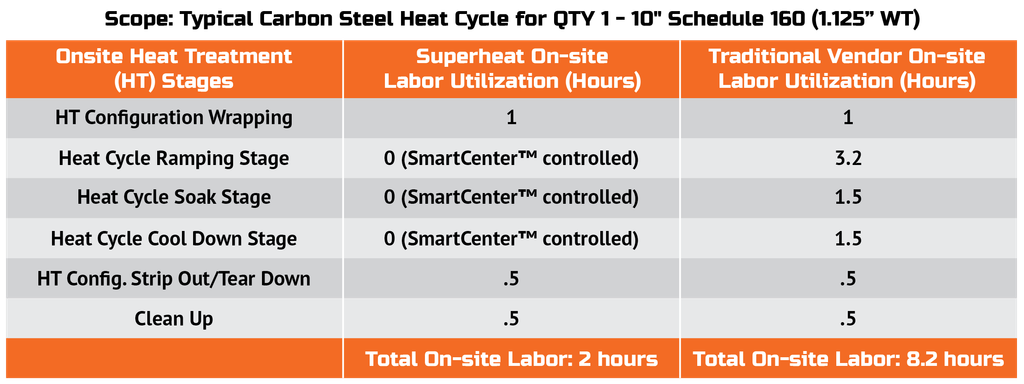
During the 6.2 hours of SmartCenter™ control, technicians can focus on other wrapping and teardown activities.
Specifications & assumptions:
- Pipe Wall Thickness: 10″ Sch. 160 carbon steel pipe with a WT of 1.125 in
- Soak Time Basis: Calculated using Superheat’s Heat Cycle Parameters of 1 hour per inch of WT, rounded to the nearest 0.5 hr, resulting in a 1.5hr soak time
- Heating Ramp Rate: Based on conservative code requirements of 400°F/hr divided by maximum wall thickness, which is equivalent to: 355°F/hr when calculated using wall thickness (400 ÷ 1.125) and 250°F/hr when calculated using the rounded 1.5 hr soak time (400 ÷ 1.5)
- Target Soak Temperature: 1150°F
- Time to Reach Soak: 3.2 hr from ambient to 1150°F based on a heating rate of 250°F/hr
- Soak Duration: 1.5 hours at 1150°F
- Controlled Cooling: Calculated from 1150°F to 600°F, which is the typical temperature where controlled cooling requirements end and charting is discontinued
- Cooling Time: 1.5 hr based on a cooling rate of 355°F/hr
- Estimated Total Cycle Time: 6.2 hr (3.2 hr ramping + 1.5 hr soak + 1.5 hr cooling)
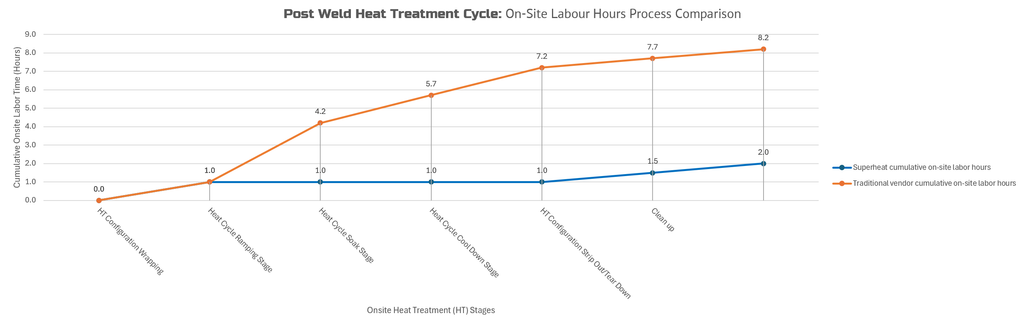
Consider a typical carbon steel heat treatment cycle for QTY 1 – 10″ schedule 160 (1.125” WT). Using a traditional approach, monitoring personnel are on-site throughout the heat treatment configuration wrapping, ramp-up, soak, cool-down, and tear-down stages, resulting in about 8.2 hours of on-site heat treatment labor.
Using the Superheat’s SmartWay™ solution, the ramp-up, soak, and cool-down stages are monitored and controlled remotely through the Superheat SmartCenter™. The result is approximately 2 hours of on-site labor utilization for the same scope. That represents a 75.6% reduction in on-site labor hours compared to traditional execution methods, or 75.6% more time for a technician to focus on setting up future scope.
While every project is different, the comparison highlights a broader industry trend: advances in digital execution allow facilities to complete essential heat treatment work with dramatically smaller on-site footprints.
A Better Fit for Today’s Risk Assessments
Many industrial facilities now evaluate contractors not only on technical capability and price, but also on how they contribute to overall site risk management. Reducing the number of people exposed to hazards has become a key objective across industrial operations. Whether driven by safety initiatives, workforce limitations, or operational efficiency goals, organizations are actively seeking opportunities to reduce unnecessary site presence.
Heat treatment has historically been viewed as a process that required continuous on-site attendance. Superheat SmartCenter™ enabled execution challenges that assumption. By diversifying preemptive fail-safes and relocating equipment control and monitoring from the on-site workface to a dedicated remote operations environment, facilities can reduce personnel exposure while maintaining full process visibility. Far more than a remote monitoring solution, the system incorporates redundant digital and physical fail-safes that continuously verify critical operating parameters and automatically respond to abnormal conditions, helping ensure safe operation and consistent achievement of intended heat cycle outcomes. Learn more here: Behind-the-Scenes of the Superheat SmartCenter™.
The Next Evolution of On-Site Heat Treatment is Here
For decades, heat treatment improvements focused on equipment performance, temperature control, and process quality. Those factors remain critical today, but increasingly, another measure of performance is emerging: How many people does it take to complete the work safely and successfully?
The answer may be fewer than many facilities think.
By combining digital control, real-time monitoring, and remote execution through the SmartCenter™, we help clients rethink what on-site heat treatment looks like on today’s industrial projects, reducing on-site labor requirements while saving time, lowering costs, and minimizing risk.
To learn more about the Superheat SmartCenter™ capabilities or to discuss your next on-site heat treatment project, send us a message through our Contact Us form today!
